On this page
Keyword cannibalization happens when two or more pages on your site target the same keyword and the same buyer intent. Google's ranking signals split between the pages, neither reaches the position it could hold alone, and the traffic the page should produce gets diluted. For B2B SaaS sites with multiple content surfaces (product pages, use-case pages, blog content, documentation), cannibalization is structural rather than accidental.
Daydream's research on B2B SaaS cannibalization documents the financial impact at up to 11 percent reduction in free trial starts when cannibalization goes unaddressed across PLG funnels. This post covers the four B2B SaaS cannibalization patterns, the diagnostic discipline using Google Search Console and SEO tools, the four-option fix framework, and the keyword map discipline that prevents cannibalization from recurring.
01What keyword cannibalization actually is for B2B SaaS sites
Keyword cannibalization is an SEO problem that occurs when multiple pages on a site target the same keyword and serve the same purpose, harming each other's search rankings. The problem is widespread enough that Yoast describes it as one of the most common content maintenance issues for growing sites. B2B SaaS sites are structurally more vulnerable than other site types because the content architecture multiplies overlap surfaces.
What cannibalization actually is
Cannibalization is not the same as duplicate content (identical content across pages) or content overlap (similar topics, different intent). Cannibalization specifically means two pages competing for the same keyword AND the same search intent. The competition fragments Google's ranking signals: backlinks split across the pages, internal authority dilutes, and the SERP-displayed page may not be the page the program would have chosen. Semrush's research shows that affected pages typically rank 3 to 8 positions lower than they would if one page held all the signals.
This post operates within the keyword research sub-pillar covering discovery methodology for B2B SaaS programs. The foundational keyword research methodology lives in the keyword research operator framework for B2B SaaS programs.
Why B2B SaaS sites get cannibalization more often
B2B SaaS sites typically host four content surfaces that target buyer intent in overlapping ways: product or feature pages, use-case pages organized by persona or industry, blog content covering category education, and documentation that surfaces in search for branded queries. Each surface serves a distinct purpose, but the keywords they target often overlap. A product page for "time tracking software," a blog post titled "what is time tracking software," and a use-case page for "time tracking software for agencies" all target overlapping queries unless explicitly differentiated. The architecture produces cannibalization unless the keyword map enforces separation.
02The four B2B SaaS cannibalization patterns
Across our B2B SaaS engagements, four patterns account for nearly every cannibalization case. Each pattern has a structural cause and a different fix priority. Programs that recognize their pattern can ship the right fix in days. Programs that ship generic fixes often make the problem worse.
Pattern 1: Product page vs documentation page
The most common B2B SaaS cannibalization pattern. The product page targets the branded query (e.g., "Acme CRM"), and the documentation page also surfaces for the same query because both have the brand in the title. Lazarina Stoy at Wix documents this specifically: a SaaS company's product or service page outranking their documentation page for a branded query containing the term API documentation. The fix is usually no-change (the pages serve different intent) unless the wrong page is winning, in which case strengthen internal linking and on-page signals toward the intended winner.
Pattern 2: Use-case page vs blog post
A use-case landing page targeting "time tracking for marketing agencies" and a blog post titled "How marketing agencies track time across client projects" both target the same persona-plus-use-case query. The use-case page is built to convert, the blog post is built to inform. Both rank for the query and dilute each other. The fix is usually differentiate: rewrite the blog post to target an adjacent informational query and direct the page to convert traffic via the use-case landing page.
Pattern 3: Comparison page vs feature page
The program ships a "vs" comparison page targeting "Acme vs Competitor" and a feature page that mentions "Acme is better than Competitor" in marketing copy. Both rank for the comparison query. The feature page often outranks the comparison page despite serving worse intent. The fix is merge (consolidate the competitive content into the comparison page) and rewrite the feature page to focus on the feature, not the comparison.
Pattern 4: Persona page vs industry page
The program produces both "CRM for SaaS founders" (persona) and "CRM for software companies" (industry) targeting heavily overlapping search intent. Buyers searching either query expect similar content. Both pages compete unless explicitly differentiated. The fix is usually merge into one canonical page with sections addressing both audiences, or differentiate by making the persona page tactical and the industry page strategic. If you want help running the four-pattern audit on your site, book a 30-minute cannibalization audit with our team.
03Diagnosing cannibalization with Google Search Console
Google Search Console (GSC) is the most accurate cannibalization diagnostic tool for B2B SaaS programs because it shows the actual queries each page receives impressions and clicks for. The diagnostic process takes about 30 minutes per priority keyword and runs without any tooling beyond GSC access.
The GSC query-by-page diagnostic
The methodology comes from Yoast's classic cannibalization guide and remains the industry standard. Sign into Search Console. Navigate to Performance, then Search Results. Filter by the suspected query. Switch to the Pages view. If more than one URL receives impressions for that query, examine whether the pages serve the same intent. If yes, cannibalization is confirmed.
A simpler alternative is the site search method. Run site:yourdomain.com "your target keyword" in Google. The results show every page on your domain that Google associates with the keyword. Two or more pages indicate potential cannibalization.
Reading the signal: when overlap is real
Multiple pages ranking on the same query within the top 100 is not always cannibalization. The signal is real when three conditions hold: the pages share buyer intent (both informational, both commercial, or both transactional), the pages trade impressions over time (the trend shows one page winning then the other), and clicks concentrate on a single page while impressions distribute across multiple. Programs that audit without checking these three conditions often flag false positives where Google has simply indexed related pages without ranking conflict.
04Diagnosing with SEO tools
GSC works well for known suspected queries. For site-wide cannibalization audits across hundreds or thousands of keywords, dedicated SEO tools are faster and more comprehensive. Three tool categories cover most B2B SaaS audit needs.
Position tracking with cannibalization reports
Semrush's Position Tracking tool includes a Cannibalization Report that surfaces every keyword where multiple pages rank in the top 100. The report grades the site's overall Cannibalization Health and filters by keyword, URL, or position. The setup takes 15 minutes for a domain with under 1,000 tracked keywords. Ahrefs has equivalent functionality through Rank Tracker and Site Explorer's organic keywords report.
Site Audit-based detection
Ahrefs' Site Audit includes content cannibalization checks that surface pages with similar titles or topical overlap. The tool catches the cases where two pages were created without checking against each other. Semrush Site Audit provides similar reports.
Dedicated cannibalization checkers
Several tools specialize in cannibalization detection. Unclash AI is a GSC-based audit tool that identifies page and keyword conflicts. TrueRanker flags cannibalization through rank tracking. Keylogs surfaces cannibalizing keywords from Search Console data. For programs running quarterly audits, dedicated tools save 4 to 8 hours per audit compared to manual GSC work.
05The fix decision framework: four options per page pair
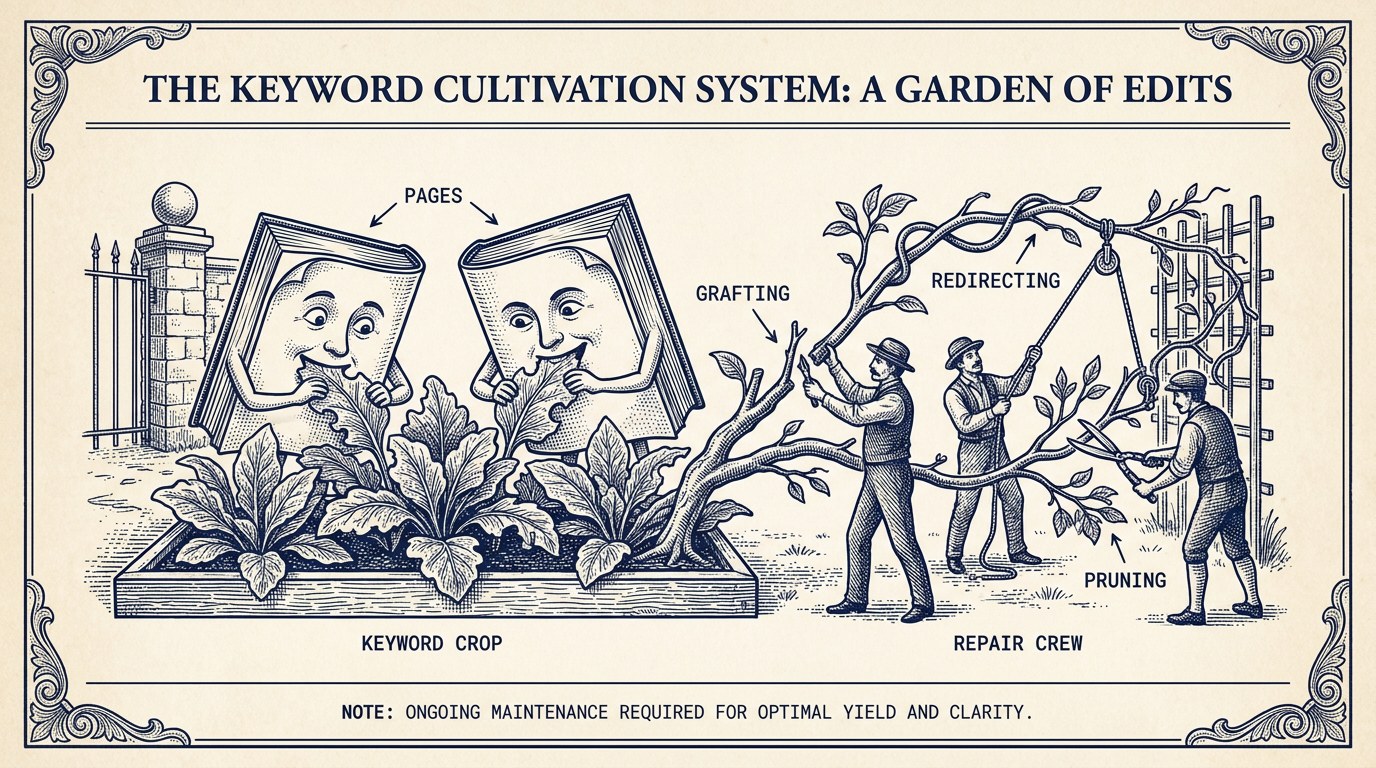
Once cannibalization is confirmed, four fix options exist. The default in most cannibalization content is "merge or redirect," but this default destroys value when applied to cases that should be differentiated or left as-is. The four-option framework matches the fix to the case.
Option 1: Merge
Combine the two pages into one canonical version. Take the strongest content from each, write the merged page on the URL with stronger backlinks and existing rankings, then 301 the weaker URL to the merged page. Best for cases where both pages serve identical intent and the audience is the same.
Option 2: Redirect
301 the weaker page directly to the stronger page without merging content. Best when the weaker page adds nothing the stronger page does not already cover. Lower production effort than merge, same SEO outcome when the content overlap is high.
Option 3: Differentiate
Rewrite each page to target distinct intent so both can rank. Best for cases where both pages have audience demand but their intent overlap is artificial. Differentiation requires editorial work but preserves two ranking surfaces, which is higher long-term value than merge or redirect when the audiences are distinct.
Option 4: No-change
Confirm the pages serve different intents and require no fix. Best for cases like Pattern 1 (product page plus documentation page on a branded query) where Google has correctly distinguished the intents and both pages rank appropriately. Programs that default to fix-mode often "fix" cases that did not need fixing, destroying signal in the process.
06Implementation: 301 redirects, canonicals, and on-page rewrites
After the fix decision, implementation is mechanical but disciplined. Three implementation patterns cover most B2B SaaS cannibalization cases. Each pattern has specific quality gates before deployment.
Implementing merges
Write the merged content on the URL that wins after audit (higher rankings, more backlinks, better intent fit). Preserve sections from the weaker page that add unique value. Set up a 301 redirect from the weaker URL to the merged URL. Update internal links across the site to point to the merged URL. Google's documentation on 301 redirects confirms that link equity transfers through the redirect within 30 to 60 days.
301 redirect rules
Implementation typically lives in the CMS or at the CDN level. Validate the redirect chain (every old URL redirects with a 301 status to the new URL with no intermediate hops). Crawl the site post-implementation with Screaming Frog or Sitebulb to confirm the redirects work and no orphaned URLs remain.
On-page rewrites for differentiation
When the fix is differentiation, the rewrite is editorial work. Identify the distinct intent for each page. Rewrite H1, meta title, meta description, and the first 200 words to clearly signal the intent. Update internal linking so context links to each page reflect the differentiated intent. The differentiation work integrates with the broader B2B SaaS SEO measurement framework that operates on the same quarterly cadence so the impact is trackable.
07Prevention: the keyword map discipline
Most cannibalization is preventable. Programs that maintain a keyword map (one row per important keyword, one URL assigned as the canonical page for that keyword) catch overlaps before publish. The keyword map is the single most effective preventive discipline in B2B SaaS keyword research.
The keyword map as preventive discipline
A keyword map has four columns: target keyword, assigned URL, content type, and buyer intent. Every new piece of content checks against the map before production starts. If a target keyword is already assigned, the new content must either target a different keyword or replace the existing assignment. The discipline takes 5 minutes per piece of new content and prevents weeks of recovery work later.
Pre-publish cannibalization checks
The pre-publish check runs in 10 minutes. First, search Google with site:yourdomain.com "primary keyword" for the new piece. Second, run the target keyword in GSC Performance to see if existing pages already rank. Third, update the keyword map with the new assignment. Programs that integrate this check into the editorial workflow catch 80 to 90 percent of potential cannibalization before publish.
08Common failures and the partial-fix trap
Three failure patterns account for most underperforming cannibalization audits. Each one has a specific corrective discipline. The chapter also addresses the partial-fix trap, which is the most damaging pattern because it produces visible activity without producing recovery.
Failure 1: the partial-fix trap
The most damaging failure is shipping fixes for some cannibalization cases while ignoring others. The site shows partial improvement on the fixed pages but flat overall performance because the unfixed cases still drag rankings. Programs that audit comprehensively and fix every confirmed case in one production cycle recover faster than programs that fix one case per week.
Failure 2: redirecting without consolidation
Redirecting the weaker page to the stronger page without moving the weaker page's unique content into the stronger page destroys the SEO value the weaker page produced. The redirect transfers link equity, but the user experience degrades and the page's content advantage disappears. The fix is always evaluating whether merge is needed before defaulting to redirect.
Failure 3: ignoring intent-level cannibalization
The third failure is checking only keyword overlap without checking intent overlap. Two pages may rank for the same keyword for legitimately different reasons (product page for transactional intent, blog post for informational intent). Auditing only at the keyword level produces false positives. The fix is always running the three conditions in Chapter 03 (shared intent, traded impressions, clicks-on-one-while-impressions-on-many) before declaring cannibalization.
09FAQ
What is keyword cannibalization in SEO?
Keyword cannibalization is an SEO problem that occurs when multiple pages on a site target the same keyword and serve the same search intent. Google's ranking signals split between the pages, neither reaches the position it could hold alone, and the traffic gets diluted. For B2B SaaS sites with multiple overlapping content surfaces, cannibalization is structural rather than accidental. Daydream's research documents the financial impact for B2B SaaS at up to 11 percent reduction in free trial starts when cannibalization goes unaddressed across PLG funnels.
How do I find keyword cannibalization on my site?
Use Google Search Console as the primary diagnostic tool. Filter Performance by the suspected query, switch to the Pages view, and check whether more than one URL receives impressions for that query. A simpler alternative is the site search method: run site:yourdomain.com "your target keyword" in Google. Two or more pages indicate potential cannibalization. For site-wide audits, dedicated SEO tools like Semrush Position Tracking, Ahrefs Rank Tracker, or specialized checkers (Unclash AI, TrueRanker, Keylogs) surface cannibalization across hundreds of keywords automatically.
What are the four B2B SaaS cannibalization patterns?
Across B2B SaaS sites, four cannibalization patterns account for over 90 percent of cases. Pattern 1: product page vs documentation page on branded queries. Pattern 2: use-case page vs blog post on category-plus-persona queries. Pattern 3: comparison page vs feature page on competitive queries. Pattern 4: persona page vs industry page on segmented queries. Each pattern has a different fix priority.
What are the four fix options for cannibalization?
The four fix options are: merge (consolidate two pages into one canonical version and 301 the weaker URL), redirect (301 the weaker page to the stronger page without merging content), differentiate (rewrite each page to target distinct intent so both can rank), and no-change (confirm the pages serve different intents and require no fix). Match the fix to the case based on intent overlap and audience distinction.
How long do cannibalization fixes take to show results?
Cannibalization fixes show results on a 30 to 60 day cycle after implementation. Google takes time to re-crawl the affected URLs, process 301 redirects, consolidate ranking signals, and surface the corrected page in SERPs. Programs that ship fixes and measure within 7 to 14 days catch noise rather than signal. Daydream documents the typical B2B SaaS recovery window at 90 to 120 days for full pipeline impact.
Can I use robots.txt or noindex to fix cannibalization?
Generally no. Robots.txt blocks crawling but does not consolidate ranking signals from the blocked page to the canonical page. Noindex removes the page from search results but does not transfer link equity. The correct tools for cannibalization fixes are 301 redirects (transfer signals) and canonical tags (consolidate when both pages must remain accessible).
How do I prevent keyword cannibalization?
Maintain a keyword map with four columns: target keyword, assigned URL, content type, and buyer intent. Every new piece of content checks against the map before production starts. If a target keyword is already assigned to another URL, the new content must either target a different keyword or replace the existing assignment. The pre-publish check takes 10 minutes per piece.
Part of the keyword research playbook
This is the cannibalization audit and fix framework under keyword research.
The foundational keyword research methodology and how each connects to the broader B2B SaaS SEO program lives on the parent sub-pillar.