On this page
The pitch is the bottleneck. Even well-qualified guest post targets reject the majority of pitches they receive because most pitches share the same five structural failures: generic subject lines, no demonstrated knowledge of the publication, undifferentiated topic angles, mismatched length and depth, and no operational professionalism. Programs running pitch strategy as a discipline (not just sending more pitches) earn 30 to 50% acceptance rates against the same qualified target lists where undisciplined programs earn 5 to 15%. This is the operator playbook for guest post pitch strategy in B2B SaaS: the five-part pitch anatomy that produces acceptances, the subject lines and angles that get pitches opened and accepted, and the iterative improvement loop that compounds acceptance rates over time.
01Why most B2B SaaS guest post pitches get rejected
Pitch rejection is the default, not the exception. Editors at B2B publications receive 20 to 100+ pitches per week; most get rejected within seconds based on five common failure patterns. This chapter is part of our guest posting services for B2B SaaS and the foundational understanding required before optimizing pitch quality.
The five rejection patterns
First, generic subject lines that don't differentiate from spam ("Guest post idea for [Publication]," "Quick guest post pitch"). Second, no demonstrated knowledge of the publication (pitches that could be sent to any site, no reference to specific recent content). Third, undifferentiated topic angles (proposing topics the publication has covered repeatedly or proposing topics with no specific angle). Fourth, mismatched length and depth (3-paragraph pitches to publications expecting more depth, or essay-length pitches to publications expecting brief). Fifth, operational red flags (typos, broken sentences, no clear contact information, requests for paid placement disguised as guest posts).
The editorial perspective
Editors process pitches with a specific decision framework: does this writer understand our publication, does this topic fit our current editorial direction, can this writer deliver quality content on this topic, and is the operational pitch professional enough to suggest a smooth publication process. Each rejection pattern fails at least one of these decision criteria.
The acceptance rate ceiling
Programs running pitch strategy as a discipline earn 30 to 50% acceptance rates against qualified target lists. Programs without pitch discipline earn 5 to 15% against the same lists. The 3 to 5x acceptance rate difference is the entire economic case for pitch strategy investment; the same outreach effort produces materially more published guest posts when the pitches are strong.
02The five-part anatomy of accepted pitches
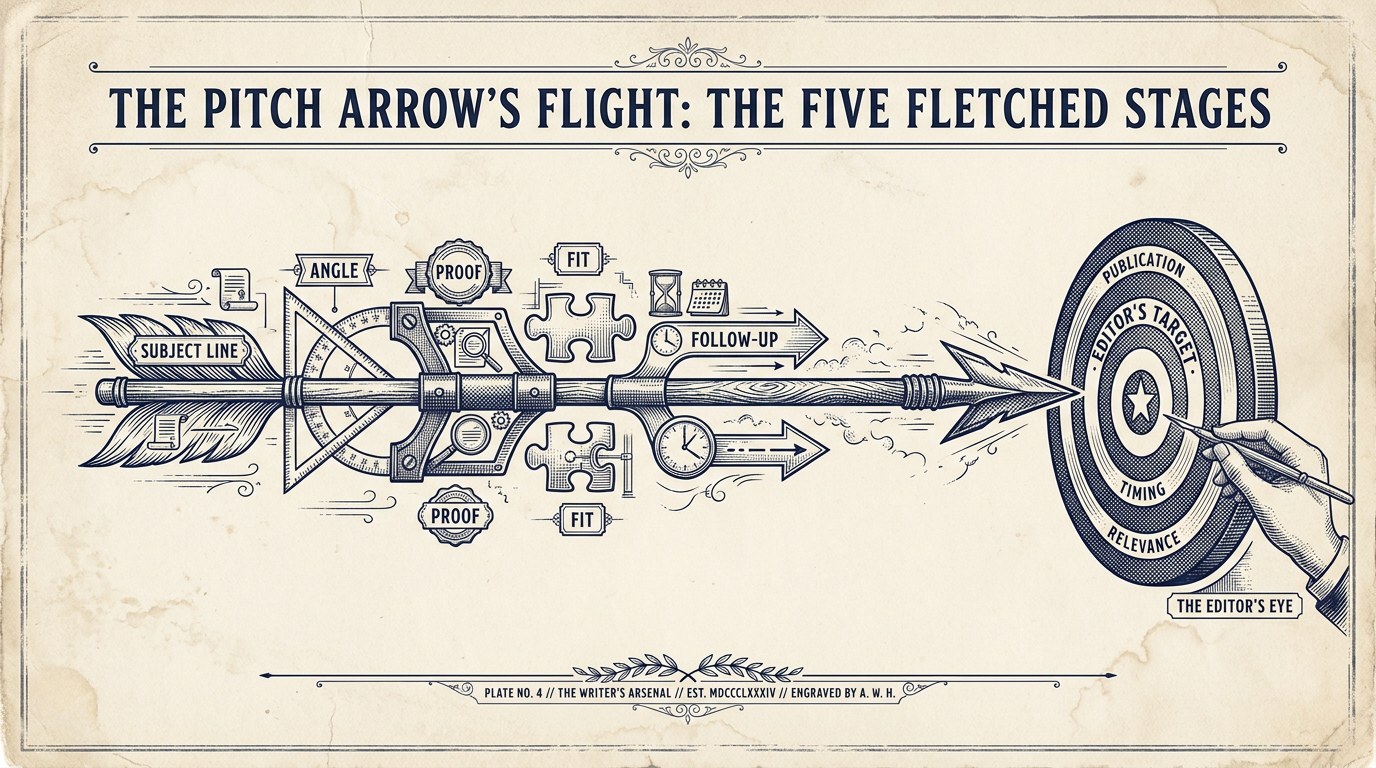
Pitches that get accepted share a consistent structural anatomy. Each part serves a specific decision criterion in the editor's pitch evaluation.
Part 1: Subject line
The subject line determines the open rate, which sets the ceiling for the rest of the pitch. Effective subject lines are specific to the proposed angle and the publication, brief enough to render fully in inbox preview (40 to 65 characters), and signal value rather than mystery. Subject line patterns covered in detail in Chapter 03.
Part 2: Recognition opener
The opening 1 to 2 sentences demonstrate the pitcher has actually read the publication. The recognition should reference a specific recent article, editorial direction, or contributor pattern, not generic compliments ("Love your blog!"). The recognition signals the pitch isn't a mass-send and that the pitcher understands the publication's context.
Part 3: Topic proposal with specifics
The topic proposal includes a specific working title, a brief description of the angle, 3 to 5 specific points or sections the piece would cover, and the proposed depth or word count. The specificity prevents the "we'll figure out the details after acceptance" pattern that editors learn to reject because it produces inconsistent finished pieces.
Part 4: Value proposition
The value proposition explicitly addresses why the publication's readers would benefit from the proposed piece. The framing should connect to the publication's audience (which the recognition opener demonstrated knowledge of) and to the topic gap the piece would fill. Pitches that focus on what the pitcher gets from publication (link, exposure) instead of what readers get from reading underperform pitches with reader-centric value propositions.
Part 5: Closing with response next step
The closing offers the editor a clear next step: would you like me to send a full draft, would you like to see an outline first, should I share writing samples first, what timeline works for you. The clear next step lowers the editor's cognitive load (no need to figure out what to ask for) and signals operational professionalism. Pitches that close without a clear next step often receive no response simply because responding requires extra editor work.
03Subject line patterns that get pitches opened
Three subject line patterns produce reliable open rates. Each works for a different pitch type.
Pattern 1: Specific topic plus publication reference
Format: "[Specific topic] piece for [Publication name]" or "[Specific topic] in [Publication name] readership terms." Examples: "ICP research methodology piece for [Publication]," "Schema markup operator deep-dive for [Publication]." This pattern works for established publications where the publication name carries weight; the format signals understanding of the editorial context.
Pattern 2: Specific data point or finding
Format: "[Specific surprising finding]: pitch for [Publication]." Examples: "78% of B2B SaaS programs skip ICP research: pitch for [Publication]," "B2B SaaS pricing decisions made by procurement at 60% rate: pitch for [Publication]." This pattern works when the proposed piece is data-driven; the subject line surfaces the headline finding the editor would lead with if they accepted.
Pattern 3: Direct response to specific editorial content
Format: "Building on your [recent specific article]: pitch idea." Examples: "Building on your AI Search measurement piece: pitch for follow-up coverage," "Building on your B2B SaaS pricing analysis: pitch for the procurement angle." This pattern works when the pitch is genuinely a response to specific recent editorial content; the subject line proves the recognition is real.
Subject line patterns that fail
Generic subject lines ("Guest post pitch," "Quick question," "Pitch idea"), urgency-creating subject lines ("Final pitch opportunity," "Last chance"), and overly clever subject lines that obscure the actual proposal all underperform. The discipline is signal value (specific topic, specific publication context) over creativity for its own sake.
04Topic angles editors actually respond to
Three properties separate topic angles editors respond to from angles that get rejected.
Property 1: Current editorial direction alignment
The topic addresses a current editorial direction the publication is investing in. The signal: the publication has published 2 to 4 pieces on related topics in the last 60 to 90 days, indicating the topic area is active for them. Topics aligned with editorial direction get accepted at materially higher rates than topics misaligned with what the editorial team is currently prioritizing.
Property 2: Specifics the publication doesn't already have
The pitch offers specifics (data, framework, named examples, original analysis) the publication's recent content doesn't already include. The signal: the pitcher has the source of specifics (original research, in-house data, specific operational expertise) the publication can't easily produce themselves. Topics with strong specifics get accepted because they add genuinely new information to the publication's coverage.
Property 3: Pitcher qualification demonstration
The pitch demonstrates why the pitcher is qualified to write on the topic. Qualifications that matter: documented experience operating in the space, prior content with specific results, named clients or projects, or original data the pitcher has access to. Generic qualifications ("CEO of B2B SaaS company") matter less than topic-specific qualifications ("led the ICP research project at [Specific company] that produced [Specific outcome]").
Why these properties matter together
The three properties compound. A topic with editorial direction alignment but no specifics is one of dozens of similar pitches. A topic with strong specifics but misaligned with editorial direction gets passed over. A topic with both but weak pitcher qualification creates editor uncertainty about delivery quality. All three present produce reliably accepted pitches.
05Pitch length and depth calibration by site type
Different publications expect different pitch lengths and depth. Mismatched calibration produces rejection independent of pitch content quality.
Brief publications (under 200 words)
Some publications expect very brief pitches: a 3 to 4 sentence working title, 2 to 3 bullet points, and a sign-off. These publications often have editorial throughput requirements that favor brief pitches. Sending essay-length pitches to brief-pitch publications signals the pitcher doesn't understand the publication's operational reality.
Standard publications (200 to 400 words)
Most B2B publications expect standard-length pitches: opening recognition, topic proposal with 3 to 5 specifics, brief value proposition, brief qualification, clean closing. The five-part anatomy from Chapter 02 fits naturally in this range. Most pitch templates and pitch strategy guidance assume this range.
Deep publications (400 to 800 words)
Some publications (analytical publications, long-form-focused publications, research-driven publications) expect deeper pitches with explicit framework or thesis development, multiple specifics with supporting reasoning, and demonstrated expertise. Brief pitches to deep-expecting publications signal the pitcher won't be able to deliver the depth the publication ships.
Calibration signals
The contributor guidelines often specify pitch length expectations. Recent published pieces signal the depth expectation (a publication shipping 3,000-word pieces expects pitches signaling that depth capacity). Editorial responses to prior outreach (if any) signal the operational tone the publication uses. Calibrate the pitch length and depth to these signals; mismatch produces avoidable rejection.
06Rejection handling and follow-up discipline
Rejection is data. The discipline of handling rejection well determines whether the program improves or repeats the same patterns.
Categorizing rejection types
Three rejection categories matter operationally. "Not a fit" rejections (topic doesn't match editorial direction): the rejection signals topic misalignment, not pitch quality issues. "We've covered this recently" rejections: the rejection signals topic timing issues, the topic might work later. "Not the right angle" rejections: the rejection signals angle-specific issues but the underlying topic might work with a different framing. The categorization drives different response strategies.
The response discipline
When rejected with specific feedback, respond briefly and professionally: thank the editor for the response, acknowledge the feedback, and either pivot the pitch ("would [Different angle] be a better fit?") or close gracefully ("I'll keep an eye on your editorial direction and pitch when I have a better fit"). The response builds the editorial relationship; ignored rejections don't.
Follow-up timing
For pitches with no response (the most common outcome), follow-up timing matters. The first follow-up should come 7 to 10 days after the initial pitch with a brief subject line ("Following up on [Original subject]") and a 2 to 3 sentence body. The second follow-up should come 7 to 14 days after the first with an even briefer message. After two follow-ups without response, the discipline is to close the loop and move on; further follow-ups annoy editors and damage future pitch reception.
Building editorial relationships through rejection
Rejection-handled-well builds editorial relationships. Editors who reject one pitch professionally remember the pitcher's response and become more open to future pitches. Programs that handle rejection as relationship investment (not just transactional outcome) compound their acceptance rates at specific publications over time.
07The iterative pitch improvement loop
Pitch improvement requires structured iteration. Three loop components matter.
Per-pitch retrospective
After each pitch outcome (acceptance, rejection, no response), document what happened: subject line used, topic angle, length, response received, response time. The documentation becomes the data set for retrospective analysis. The B2B SaaS content writing operator framework covers complementary documentation patterns for content production retrospectives.
Monthly pitch analysis
Monthly cadence: review the previous month's pitch outcomes, identify patterns (which subject line patterns produced highest open rates, which topic angles got accepted most, which publications responded fastest), and adjust the next month's pitch strategy. The monthly review compounds learning across pitches; without it, the program repeats the same mistakes.
Quarterly pitch portfolio review
Quarterly cadence: review the program's full pitch portfolio across publications, identify which publications produce reliable acceptances (high-leverage targets to invest in more), which produce inconsistent results (lower priority), and which produce no acceptances (consider disqualifying from future prospecting). The portfolio review prevents the program from continuing to invest in low-yielding target relationships.
The compounding effect
Pitch acceptance rates improve materially over 6 to 12 months when the iterative loop is operated consistently. Programs that ship and forget pitches earn the acceptance rate their initial discipline produces. Programs that iterate compound acceptance rates from 15 to 20% to 35 to 50% over 12 months without changing prospecting quality.
If you want this pitch strategy framework running on your program, book a 30-minute pitch strategy audit with our team. Compare engagement options for guest posting programs of different scales.
08Common failure modes and operational fixes
Four dominant failures.
The "generic pitch template" failure: programs sending the same pitch template across all targets without per-publication customization, producing low acceptance rates. Fix: customize the recognition opener and topic angle per pitch; the five-part anatomy from Chapter 02 leaves three parts (subject line, recognition, value proposition) requiring per-pitch customization.
The "topic without specifics" failure: programs pitching broad topics without the data, framework, or specifics that editors want. Fix: define the specifics before writing the pitch; topics without specific value propositions get rejected regardless of pitch quality.
The "no follow-up discipline" failure: programs sending pitches and abandoning them without follow-up, missing 30 to 50% of acceptances that come after the second touch. Fix: ship the follow-up cadence from Chapter 06 (7 to 10 days for first follow-up, 7 to 14 days for second, then close).
The "no iteration" failure: programs sending pitches without per-pitch documentation or monthly retrospective, repeating the same mistakes for years. Fix: ship the iteration loop from Chapter 07; even simple tracking produces measurable acceptance rate gains over 6 to 12 months.
Part of the guest posting playbook
This is one chapter of the guest posting sub-pillar.
The strategic framework covering guest posting as a discipline, prospecting, outreach, pitching, and how it integrates with the broader link building program, lives on the parent sub-pillar.