On this page
Competitive SEO is the discipline of understanding what your direct competitors rank for, how they earn backlinks, what content they produce, and how AI Search engines cite them, then acting on the gaps that matter. Most B2B SaaS programs run competitive analysis as a quarterly screenshot exercise. They pull a Semrush report, look at the numbers, and file the document.
The discipline this post covers is different. It treats competitive intelligence as a four-quadrant matrix where each quadrant produces a specific action. The output is a scorecard the CMO can defend in a board meeting and a quarterly plan the SEO team can execute against.
01What competitive B2B SaaS SEO strategy actually is
Competitive SEO strategy is the discipline of using competitor data to inform your own SEO roadmap. It is not about copying what competitors do. It is about reading the gaps, the patterns, and the moves that signal where the category is going. This chapter sets the scope: what competitive SEO strategy is, what it is not, and when B2B SaaS programs should invest in it.
What competitive SEO strategy is and is not
Competitive SEO strategy is informed decision-making. You see what competitors rank for, where their backlinks come from, what content they produce, and how AI engines cite them. You use that data to identify gaps in your own coverage worth closing. The output is a prioritized list of actions specific to your program. Competitive SEO strategy is not copying competitor moves. The fastest way to lose category positioning is to build your roadmap around what someone else is doing.
The implementation operates within the B2B SaaS SEO strategy sub-pillar covering the decision layer above tactical execution and connects to the full B2B SaaS SEO operator reference for category leaders at the pillar level.
Why B2B SaaS competitive sets are different
B2B SaaS markets are usually smaller and more concentrated than consumer markets. Most B2B SaaS programs have 5 to 15 direct SEO competitors. Some categories (enterprise vertical SaaS) have 3 to 5. This concentration is a feature, not a bug. Smaller competitive sets mean tractable analysis: you can read every competitor's entire content output in a quarter. The signal-to-noise ratio is higher than in consumer SEO, where competitor sets sprawl into the hundreds.
The other distinguishing feature of B2B SaaS competitive sets is positioning specificity. Two B2B SaaS companies that both sell project management software can be entirely different competitors based on whether they target enterprise versus SMB, vertical versus horizontal, or category creators versus extenders. The competitive set has to be qualified by positioning, not just by category.
The right time to invest in competitive intelligence
Three signals indicate it is time to invest in structured competitive intelligence. First, the program has matured past the initial growth stage and is now competing for the same keywords as established players. Second, the category has 5 or more well-funded entrants producing content at velocity. Third, AI Search citations are starting to influence buyer journeys. Programs missing all three usually do better focusing on their own content velocity than on competitive analysis.
The wrong signal to invest is anxiety about a single competitor's recent move. Reactive competitive analysis produces reactive content. Strategic competitive analysis happens on a quarterly cadence with a structured framework, and that is what the rest of this post covers.
02The four-quadrant competitive SEO matrix
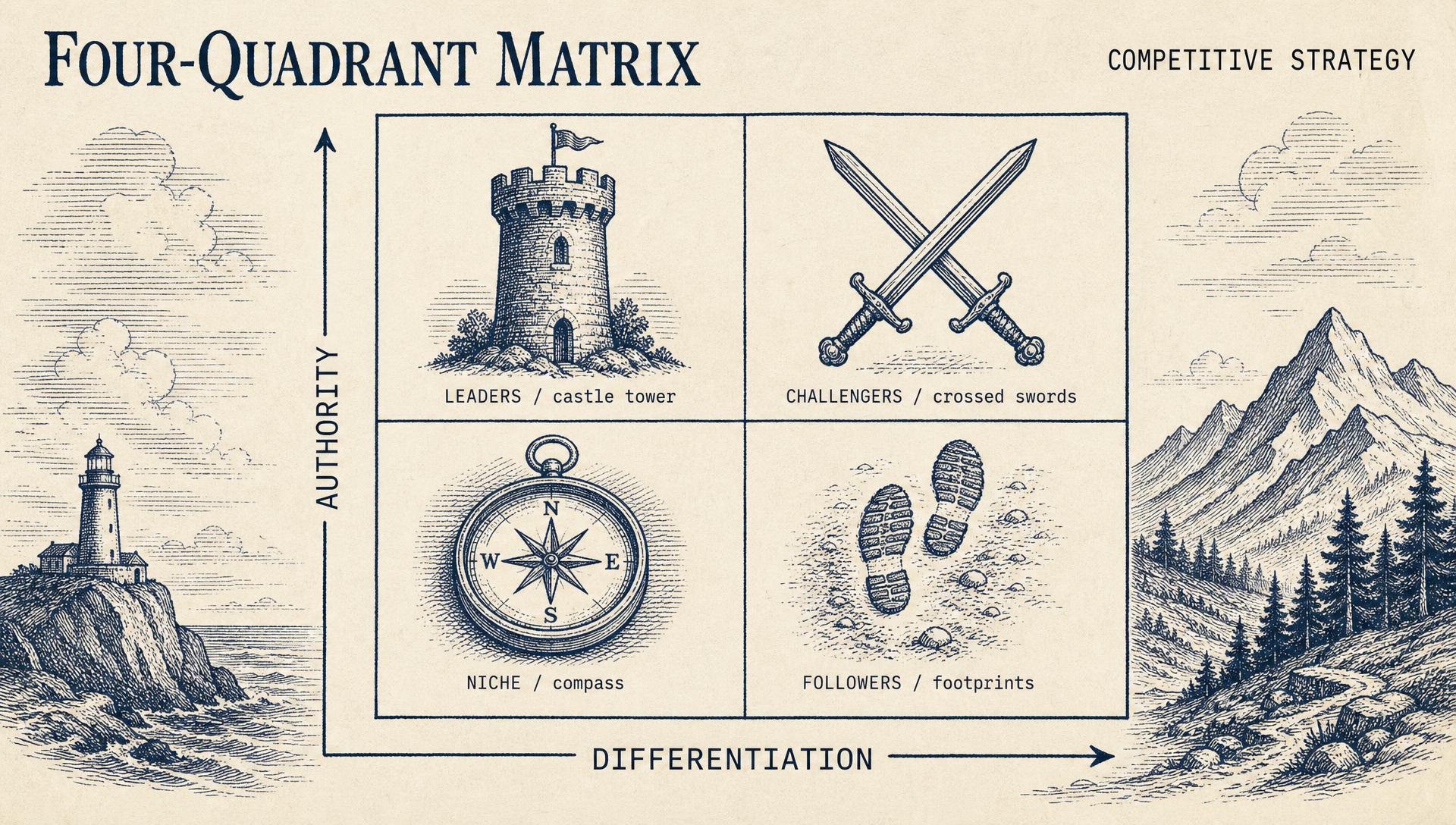
The framework. Four lenses, each measuring a different dimension of competitive position. Used together, the matrix produces a complete picture of where you stand and what gaps matter. Used in isolation, any single quadrant produces partial signal that misses 75 percent of the competitive reality.
The four lenses every competitive SEO analysis needs
The four quadrants are: keyword overlap (what your competitors rank for that you do not, and vice versa), thematic share of voice (which competitor owns each topical cluster in your category), backlink and digital PR gap (which authoritative sources link to competitors but not to you), and AI Search citation share (which competitors get cited by ChatGPT, Perplexity, and Google AI Overviews on buyer queries in your category).
Quadrant 1 is the most tracked because every SEO tool measures it. Quadrants 2 and 3 are tracked by mature programs. Quadrant 4 is tracked by almost nobody despite being increasingly important. The matrix forces parity across all four because each one surfaces gaps the others cannot see.
How the quadrants connect
The quadrants are not independent. Quadrant 1 (keyword overlap) feeds Quadrant 2 (thematic share of voice) because individual keywords cluster into themes. Quadrant 3 (backlink gaps) often explains Quadrant 1 patterns: competitors rank for keywords you do not because they have backlink equity you do not have. Quadrant 4 (AI citation share) often correlates with Quadrant 2 (thematic share of voice) because AI engines cite the sources they have learned to associate with each topic.
The quadrants connect through one analytical step: prioritizing the gaps. After running each quadrant separately, the matrix consolidates the gaps into a single action list ranked by strategic impact. The consolidation step is what makes the matrix actionable rather than just analytical.
The named framework
The four-quadrant competitive SEO matrix is the named framework this post introduces. Each cluster post under the strategy sub-pillar covering competitive intelligence and category positioning cross-references the matrix where the quadrants surface. The naming is intentional. Programs that adopt the framework refer to "Quadrant 3 backlink gaps" in operational conversations, which improves the signal-to-noise ratio of competitive discussions.
The remaining chapters (03 through 06) cover each quadrant in operational detail. Chapter 07 covers the scorecard that consolidates them. Chapter 08 covers the failures that defeat the framework when teams misapply it.
03Quadrant 1: keyword overlap with direct competitors
Keyword overlap is the most familiar competitive lens. Every SEO tool produces it. Most programs track it. The discipline difference between programs that get value from keyword overlap and programs that do not is the qualification of which competitors to include and the acting discipline on the gaps surfaced.
Identifying your true SEO competitors
Your true SEO competitors are not always your true business competitors. A company that competes for the same enterprise deals you compete for may rank on entirely different keywords because their content strategy is different. A company you do not consider a business competitor may rank on every keyword your buyers search because their content strategy overlaps yours. The right competitive set for keyword overlap analysis is the top 10 sites that rank on your top 100 commercial keywords, qualified by domain authority and content recency.
Ahrefs, Semrush, and Sistrix each produce competitive overlap reports. The qualification step is dropping low-quality domains (forums, aggregators, dictionaries) that show up in the report but are not strategic competitors. The qualified list should produce 5 to 15 competitors.
The keyword overlap analysis
Run the overlap analysis at three levels. First, head terms (the 5 to 15 highest-volume keywords in your category). Who ranks top 10 for each? Where do you sit? Second, commercial mid-tail (the 50 to 100 keywords with buying intent at moderate volume). Who owns which clusters? Third, long-tail informational (the hundreds of supporting queries). Where does your content velocity put you versus competitors?
The overlap data produces three signals: keywords competitors rank for that you do not (gaps to close), keywords you rank for that competitors do not (your moat to defend), and keywords nobody ranks for well (opportunity). Most programs spend disproportionate attention on the first signal and not enough on the second. Defending the moat is often higher impact than closing gaps because the moat is already producing pipeline.
Acting on the keyword gap
For each gap keyword worth closing, the action is creating content that competes against the existing top 10. The discipline is qualifying which gaps are worth closing based on volume, buyer intent, and your own positioning. A keyword that ranks competitors well but does not produce qualified buyers for you is not worth closing. A keyword that produces qualified buyers but the competitor content is mediocre is the highest-priority gap. If you want help running the keyword overlap analysis against your competitive set, book a 30-minute competitive SEO audit with our team.
04Quadrant 2: thematic share of voice across the category
Thematic share of voice is the quadrant most programs miss. Keyword-level share of voice tracks individual ranking positions; thematic share of voice tracks who owns the topical territory. The distinction matters because B2B SaaS buyers do not search single keywords. They research themes across 5 to 20 queries over weeks. The competitor who owns the theme captures the buyer journey, not just the individual ranking position.
Defining your thematic territory
Your thematic territory is the set of 5 to 15 topical clusters that define your category. For a project management B2B SaaS, the themes might be: agile project management, project portfolio management, resource capacity planning, project budgeting, and team collaboration. Each theme contains 20 to 50 keywords. Together, the themes represent the conversation your buyers have when researching your category.
The thematic definition is the most important step. Programs that define themes too narrowly track minor categories and miss strategic positioning. Programs that define themes too broadly track everything and lose actionable signal. The right thematic territory is qualified by your positioning: themes where you want to be known as the answer.
Measuring thematic share of voice
Thematic share of voice combines visibility across every keyword in a theme. The metric is the share of ranking position-weighted visibility across the theme's keyword set. Position 1 weight is 1.0, position 2 weight is 0.65, position 3 weight is 0.45, and so on through position 10. Sum the weighted ranks for your domain across all keywords in the theme. Divide by the total available share-of-voice. The result is a percentage that says we own X percent of theme Y, our top competitor owns Y percent, the third position owns Z percent.
The metric is more stable than keyword-level ranking and more strategic. Quarter-over-quarter change in thematic share of voice tells you whether you are gaining or losing the theme. The pattern integrates with the cross-pillar measurement framework tracking organic outcomes on a quarterly cadence and feeds the executive scorecard.
Closing share-of-voice gaps
For each theme where a competitor leads, the action is content depth: producing more high-quality content within the theme than the competitor has. Sometimes the gap is volume. Sometimes the gap is authority (their articles get more backlinks). Sometimes the gap is recency. The matrix in Chapter 07 ranks gaps by closability versus strategic value.
05Quadrant 3: backlink and digital PR gap analysis
The third quadrant covers backlink and digital PR gap analysis. Competitors that rank where you do not often have backlink equity you do not have. The gap analysis surfaces which authoritative sources link to competitors but not to you, which becomes a digital PR target list. This quadrant produces the most actionable list of all four because each gap maps directly to an outreach opportunity.
Auditing backlink gaps systematically
The backlink gap audit runs in three steps. First, export every competitor's referring domains from Ahrefs or Semrush. Second, deduplicate against your own referring domains. The difference is the gap list: domains linking to competitors but not to you. Third, qualify the gap list by domain authority, topical relevance, and outreach difficulty. The output is a prioritized digital PR target list.
Most B2B SaaS programs have backlink gaps in three places: industry publications (TechCrunch, SaaStr, First Round Review), category-specific publications (verticals like marketing tech, fintech, or HR tech), and high-authority research aggregators. The qualification step weights each gap by the realistic effort to close it.
The digital PR dimension
Backlink gaps that map to digital PR opportunities are higher value than backlink gaps that map to guest posting opportunities. A mention in TechCrunch with a contextual link compounds differently than a guest post on a niche site. The digital PR pattern covers earning placements at scale through outreach to journalists, podcast appearances, and original research that gets picked up.
The framework integrates with the digital PR for B2B SaaS SEO operator playbook under the broader link-building pillar. The backlink gap data tells you where to pitch; the digital PR playbook tells you how to pitch.
Acting on backlink gap data
The acting discipline is converting the backlink gap list into a monthly digital PR target plan. For each high-priority gap domain, identify the journalist or editor most likely to cover your category, the specific angle that fits their coverage, and the outreach approach. The conversion rate from qualified pitch to placement is typically 10 to 25 percent for well-targeted B2B SaaS outreach. Programs running the four-quadrant matrix quarterly typically close 5 to 15 backlink gaps per quarter through systematic digital PR.
06Quadrant 4: AI Search citation share against competitors
The fourth quadrant is the newest and the most underweighted. AI Search engines (ChatGPT, Perplexity, Google AI Overviews, Claude) cite specific sources when answering buyer queries. Citation share against competitors is a measurable, actionable signal. Programs not tracking it are blind to a channel that represents an increasing share of buyer research.
How AI Search citation share works
When a B2B SaaS buyer asks ChatGPT or Perplexity about your category, the AI engine produces an answer with citations. The cited sources become part of the answer the buyer reads. Sources that get cited more often become more associated with the topic in subsequent queries. The citation flywheel compounds: high-citation sources receive disproportionate citation share over time.
Citation share is measured by running representative buyer queries against AI engines (typically 50 to 200 queries per category) and counting which domains appear in citations. The methodology integrates with the AI Search engine ranking and citation mechanism reference for B2B SaaS programs which covers the underlying citation logic.
Measuring competitor citation share
The measurement runs at the topical cluster level, not the keyword level. For each theme defined in Quadrant 2, generate 20 to 50 buyer-realistic queries. Run them through ChatGPT, Perplexity, and Google AI Overviews. Capture the citations in each response. Aggregate by domain. The output is a citation share table for each theme.
The pattern across 2025-2026: AI engines cite the sources they have learned to associate with each topic during training plus the freshest authoritative content discovered during the response generation. Established authority matters. Recent content quality also matters. Programs that combine both earn the highest citation share.
Closing the AI citation gap
For each theme where a competitor has higher citation share, the action is producing content that AI engines are more likely to cite. The discipline lives in the B2B SaaS AEO checklist for direct AI citation pickup which covers the operational details. The competitive intelligence dimension feeds the AEO work: the matrix tells you which themes have the largest competitor citation gap, and the AEO checklist tells you how to close it.
07Building the quarterly competitive intelligence scorecard
The four quadrants individually produce data. The scorecard consolidates that data into a single document the CMO can read in 15 minutes and the SEO team can execute against for the next quarter. This chapter covers the scorecard format, the cadence, and the executive review pattern that makes the matrix actionable.
The quarterly cadence
The right cadence is quarterly, not monthly. Monthly competitive reviews produce reactive content. Quarterly reviews produce strategic synthesis. The reasoning: SEO patterns take 60 to 90 days to stabilize, so monthly data is mostly noise. Quarterly data is mostly signal. The pattern across our engagements: programs running quarterly scorecards out-execute programs running monthly competitor monitoring.
The quarterly cycle: month 1 collects data across all four quadrants. Month 2 synthesizes findings into the scorecard and the action plan. Month 3 executes. Repeat. The structure forces strategic thinking instead of tactical reaction.
The scorecard format
The scorecard is a single document with five sections. First, the four-quadrant snapshot: where you stand in each quadrant versus your top 3 competitors. Second, the gap list: the 10 to 20 specific gaps surfaced across all four quadrants. Third, the action plan: which 5 to 8 gaps you will close this quarter and how. Fourth, the metrics: what you will measure to know whether the action plan worked. Fifth, the strategic context: any category shifts or competitor moves that warrant attention.
The scorecard typically runs 6 to 10 pages. Anything longer loses executive attention. Anything shorter cannot carry the data needed for strategic decisions.
Who reads the scorecard
The scorecard goes to three audiences with different reading patterns. The CMO reads the executive summary (first page) and the strategic context (last page). The SEO team reads the entire document and owns execution against the action plan. The CRO and product marketing read the gap list to understand where competitor positioning is shifting. The document serves all three by being readable at multiple depths.
08Common failures and the obsessive-competitor trap
Three failure patterns account for most underperforming competitive SEO programs. Each one has a specific corrective discipline. The chapter also covers the obsessive-competitor trap, which is the single most damaging pattern in B2B SaaS competitive analysis.
Failure 1: copying competitors instead of differentiating
The most damaging competitive failure is reading the competitive analysis and producing derivative content. The competitor ranks for X, so you produce content on X that looks like theirs. The result is content that competes head-to-head on commodity ground instead of carving out differentiated territory. Programs that build their roadmap around competitor moves lose category positioning every time.
The fix is using competitive intelligence to inform decisions, not to make decisions. The matrix surfaces gaps. The program's own positioning decides which gaps to close and how to close them differently from the competitor.
Failure 2: tracking metrics nobody acts on
The second failure is producing competitive intelligence that nobody reads or acts on. The scorecard gets generated, presented at the quarterly review, and filed. Nothing changes. The fix is tying every quadrant to a specific action in the scorecard's action plan section. If a quadrant cannot produce actionable signal, drop it. Tracking for the sake of tracking is overhead.
Failure 3: the obsessive-competitor trap
The third failure is the single most damaging pattern: obsession with one competitor's moves. The program starts checking the competitor's site weekly. Every new blog post triggers a discussion. Every backlink they earn generates a comparison. The team's attention shifts from executing the program's own strategy to monitoring the competitor's. The result is reactive, derivative, and slow.
The fix is the quarterly cadence. Competitive analysis happens once a quarter, takes one to two weeks, produces the scorecard, and then the team executes. No competitor checking between quarters. Programs that adopt the quarterly cadence ship 30 to 50 percent more content than programs running continuous competitor monitoring.
09FAQ
What is competitive B2B SaaS SEO strategy?
Competitive B2B SaaS SEO strategy is the discipline of using competitor data to inform your own SEO roadmap. It involves analyzing what direct competitors rank for, where their backlinks come from, what content they produce, and how AI Search engines cite them, then acting on the gaps that matter. The output is a prioritized list of actions specific to your program. Competitive SEO strategy is informed decision-making, not copying competitor moves.
How do you measure SEO share of voice?
SEO share of voice measures your visibility on a defined set of keywords compared to competitors. The calculation: sum the position-weighted ranking across every keyword in the set (position 1 weighted 1.0, position 2 weighted 0.65, position 3 weighted 0.45, descending through position 10), then divide by the total available share. The result is a percentage. For B2B SaaS, the discipline is measuring share of voice at the topical cluster level rather than the keyword level.
How many competitors should I track in a B2B SaaS SEO analysis?
Most B2B SaaS programs have 5 to 15 direct SEO competitors that matter. Tracking fewer than 5 misses the competitive picture. Tracking more than 15 produces noise. The right list is qualified by three criteria: companies that rank for the same commercial keywords as you, companies positioned in the same buyer market, and companies producing content at meaningful velocity.
What is the four-quadrant competitive SEO matrix?
The four-quadrant competitive SEO matrix is a framework for B2B SaaS competitive analysis. The four quadrants are: keyword overlap, thematic share of voice, backlink and digital PR gap analysis, and AI Search citation share. Programs that track only one or two quadrants miss the majority of the competitive picture.
How often should I run competitive SEO analysis?
Quarterly. Monthly competitive reviews produce reactive content because SEO patterns take 60 to 90 days to stabilize, so monthly data is mostly noise. Quarterly reviews produce strategic synthesis. The quarterly cycle works as follows: month 1 collects data across all four quadrants, month 2 synthesizes findings into a scorecard and action plan, month 3 executes.
What is AI Search citation share and why does it matter?
AI Search citation share measures how often AI engines cite your domain when answering buyer queries in your category, compared to competitors. The methodology: run 50 to 200 representative buyer queries against the AI engines, capture the citations in each response, and aggregate by domain. AI Search represents a growing share of B2B SaaS buyer research. Sources cited frequently become more associated with the topic in subsequent queries, which produces a flywheel effect.
What is the obsessive-competitor trap?
The obsessive-competitor trap is the pattern of monitoring one or more competitors continuously instead of running structured quarterly analysis. The team checks the competitor's site weekly, reacts to every new blog post, and shifts attention from executing the program's own strategy to tracking the competitor's. The fix is the quarterly cadence. Programs that adopt this discipline typically ship 30 to 50 percent more content than programs running continuous monitoring.
Part of the B2B SaaS SEO strategy playbook
The strategic framework covering this discipline and how it connects to the broader B2B SaaS SEO program lives on the parent sub-pillar.