On this page
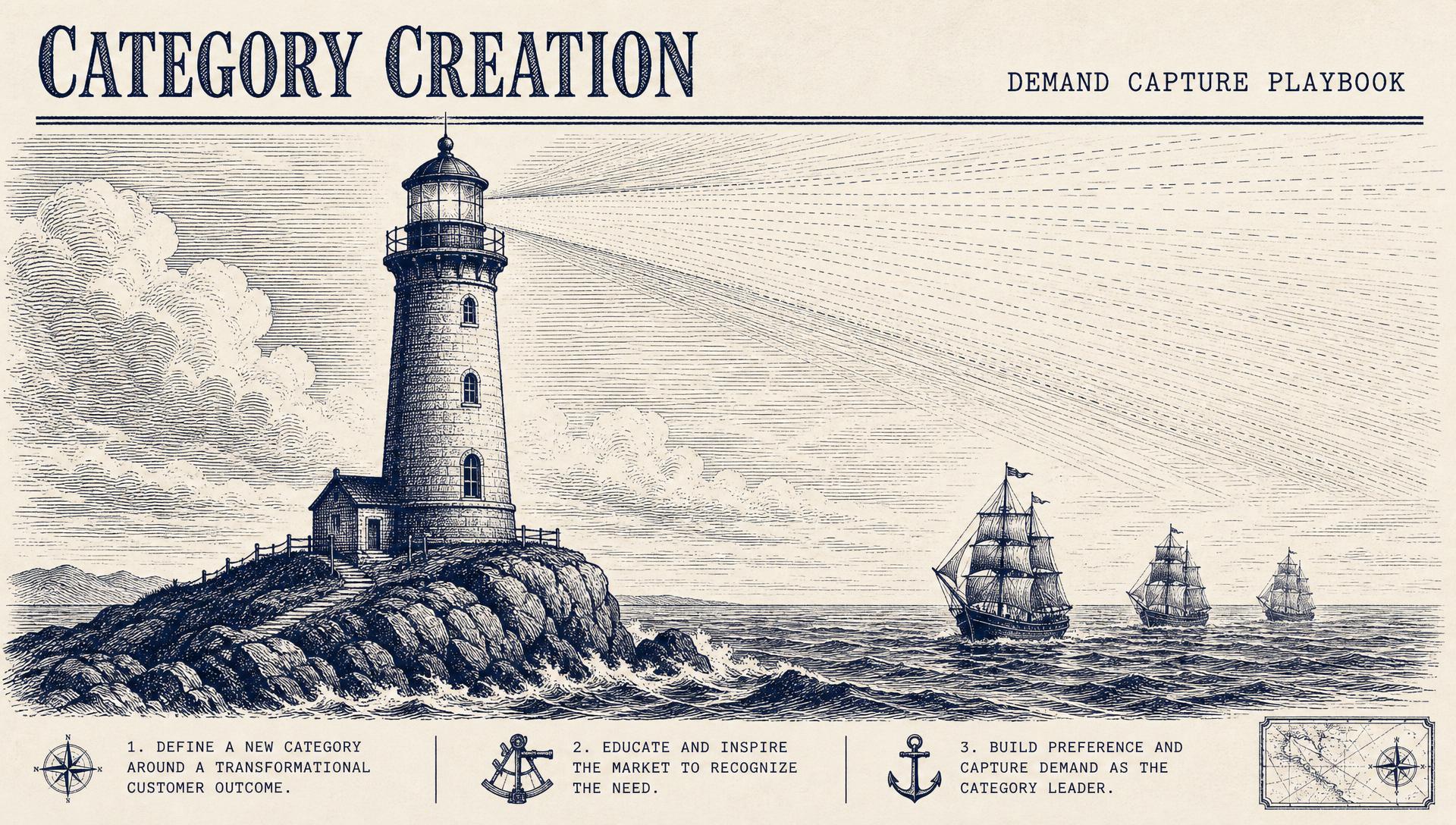
Category creation is the strategy of defining a new market and positioning your product as the default answer. Drift did it with conversational marketing. Gong did it with revenue intelligence. HubSpot did it with inbound marketing. Klaviyo did it with owned marketing. Each of these companies built a category in part through SEO operations that produced four measurable signals: they owned the category-defining keyword cluster, AI engines cited them as the category authority, category-adjacent content linked to them unsolicited, and inbound brand search grew tied to their category language.
This post covers the four signals, the SEO operations that produce each one, and the measurement discipline that tells you whether the category-creation work is producing leadership or just spending money.
01What category creation through SEO actually means
Category creation is the strategy of defining a new market and positioning your product as the default answer. The strategic theory is well covered by Play Bigger (Al Ramadan, Christopher Lochhead, Dave Peterson, Kevin Maney) and April Dunford's positioning work. What is less covered is what category creation actually looks like as an SEO operation.
Category creation in positioning theory
Play Bigger frames category creation as the work of identifying a problem nobody is solving, naming the category that emerges from solving it, and positioning your product as the category's default answer. April Dunford's framework refines positioning into a five-component model: competitive alternatives, unique attributes, value, customers, and market category. Both frameworks define what category creation is. Neither covers what the SEO execution looks like.
This post operates within the B2B SaaS SEO strategy sub-pillar covering decision-making at the program level. The post extends the strategic frameworks into operational SEO discipline.
What SEO contributes to category creation
SEO contributes four things to category creation. First, the content infrastructure that makes the category discoverable through search. Second, the topical authority signals that establish the brand as the category source for Google. Third, the citation pickup that makes the brand the category authority for AI Search engines. Fourth, the search-volume growth on category-defining terms that proves the category language is entering buyer vocabulary. Programs that do positioning without these four contributions produce categories that exist only in marketing presentations.
02The four signals of category leadership in SEO
Category leadership shows up in four measurable SEO signals. Programs that produce all four signals are the de facto category leader, regardless of what they claim in marketing. Programs that produce only one or two signals are competing for category authority but have not won it.
Signal 1: Owning the category-defining keyword cluster
Category leaders rank top 3 on 10 to 30 head-and-mid-tail keywords that define the category. Drift owns the cluster around "conversational marketing." Gong owns the cluster around "revenue intelligence." Notion increasingly owns "knowledge management" alongside Confluence. The cluster ownership shows up in Ahrefs and Semrush as concentrated keyword visibility on the category's vocabulary, typically 200 to 800 ranking positions in the top 10 across the cluster.
Signal 2: Being the source AI engines cite for category queries
When a buyer asks ChatGPT, Perplexity, or Google AI Overviews "what is conversational marketing" or "best revenue intelligence platforms," AI engines cite specific sources. Category leaders are cited in 30 to 60 percent of relevant queries. The citation flywheel compounds: sources cited frequently become more associated with the category in subsequent training, producing disproportionate citation share over time. This signal is the newest and the most underweighted in B2B SaaS strategy.
Signal 3: Earning unsolicited backlinks from category-adjacent content
When third parties (analyst firms, industry publications, competitor blog posts, peer companies) write about the category, they link to the category leader. Drift earns links from conversational-marketing-adjacent content without doing outreach. Gong earns links from revenue-intelligence-adjacent content unsolicited. The unsolicited link velocity (typically 15 to 80 new referring domains per month at category-leader scale) is a strong indicator of category authority because it represents the category language entering industry vocabulary.
Signal 4: Inbound brand search growth tied to category language
When the category language sticks, buyer behavior changes. Buyers searching "conversational marketing software" implicitly route to Drift. Buyers searching "revenue intelligence platform" implicitly route to Gong. The signal is measurable in Google Search Console: branded search volume grows alongside category-keyword search volume, indicating that the brand and the category are linked in buyer language. Programs achieving this signal often see 40 to 100 percent year-over-year growth in branded search.
If you want to walk through which signals your program is currently producing and which are gaps, book a 30-minute category-leadership SEO audit with our team.
03Building the category-defining cluster: pillar plus ecosystem
Category creation requires a content structure that signals topical authority to Google, provides citation surface area for AI engines, and gives category-adjacent content somewhere to link to. The pattern is pillar plus ecosystem.
The category pillar page
The category pillar page defines the category in your language. It explains what the category is, why it exists, what problem it solves, and how it differs from adjacent categories. The pillar typically runs 3,000 to 6,000 words, includes proprietary frameworks, and gets updated quarterly as the category evolves. Drift's content on conversational marketing operates as the pillar for that category. Gong's content on revenue intelligence operates as the pillar for that one.
The supporting cluster post ecosystem
The pillar is supported by 20 to 50 cluster posts that cover the category from every operational angle. Use-case content, comparison content (versus adjacent categories), implementation guides, ROI frameworks, persona-specific applications, and tooling content. The ecosystem ensures the category language appears across the site at scale, which signals topical authority to Google's algorithms and provides surface area for AI engines to cite.
Internal linking that reinforces category authority
Internal links across the ecosystem point back to the pillar using varied anchor text that includes the category vocabulary. Cluster posts link to each other where natural. The internal linking topology produces a hub-and-spoke pattern where the pillar accumulates link equity from across the ecosystem, which strengthens its authority signal to Google. The pattern integrates with the broader B2B SaaS SEO strategy framework covering compounding investment at the discipline level.
04Naming and language work: shaping the search queries themselves
The most powerful long-term outcome of category creation is search-query change. When the category leader's vocabulary enters buyer language, the search queries themselves use the leader's terms. The naming work compounds for years if the term sticks.
Intervention 1: Coining the term
Coining requires creating a new phrase that captures the category. "Conversational marketing" (Drift), "revenue intelligence" (Gong), "owned marketing" (Klaviyo), "inbound marketing" (HubSpot). Each phrase did not exist as a category term before the company popularized it. Drift's category-creation playbook is well-documented: David Cancel and Dave Gerhardt published a 300-page book in January 2019 (Conversational Marketing) that became the canonical reference, then offered free certification through Drift Insider. The coining work is editorial: the pillar page introduces the term, the cluster ecosystem reinforces it, and the brand uses the term in every public-facing communication.
Intervention 2: Owning the definition
Owning the definition means becoming the source that defines the category when anyone (AI engines, analysts, journalists, peer companies) needs to explain it. The pillar page is structured to be definitional: the first 200 words answer "what is [category]" cleanly. Schema.org markup confirms the page as the authoritative definition. The page earns backlinks from anyone needing to cite the definition.
Intervention 3: Building the comparison vocabulary
Comparison vocabulary is the language buyers use to evaluate options in the category. Drift built comparison vocabulary around "chatbot vs conversational marketing platform." Gong built it around "revenue intelligence vs sales analytics." Owning the comparison vocabulary means buyers evaluating options use your framing, which routes them through your evaluation criteria.
05Backlinks and PR as category-leadership proof
Backlinks and PR are not just SEO inputs in category creation. They are the proof that the category language has entered industry vocabulary. The metric is not link count alone. It is the share of category-adjacent content that links to you unsolicited.
Why category-leadership backlinks differ from generic backlinks
Generic SEO backlinks come from outreach: pitching to journalists, contributing guest posts, earning placements through digital PR work. Category-leadership backlinks come unsolicited: a competitor's blog post mentions your category and links to your pillar, an analyst firm cites your definition, a peer company recommends you when discussing the category. The unsolicited backlink velocity is the proof that your category language has spread beyond your own marketing surface. Programs achieving 15 to 80 unsolicited referring domains per month on category-adjacent content have established meaningful category authority.
The digital PR pattern for category creation
The PR pattern that produces category authority is original research and proprietary frameworks. The State of Category Report (Drift's State of Conversational Marketing, Gong's annual report) becomes the canonical reference for journalists, analysts, and peer companies. The framework becomes citable language that competitors must respond to. The pattern integrates with the B2B SaaS digital PR strategy framework for sustainable placement velocity for execution detail.
06The AI Search dimension: getting cited as the category authority
AI Search citation share is the newest category-leadership signal. Buyers asking AI engines about a category get specific source citations in the response. The source cited becomes more associated with the category in subsequent queries. Programs that ignore this signal in 2026 will be reacting to category authority decisions made in their absence.
How AI engines pick category authorities
AI engines select citations based on a combination of training-time signals (the sources the model learned to associate with the topic during training) and inference-time signals (the freshest authoritative content discovered during response generation). The training-time signals favor established authority. The inference-time signals favor recent quality. Programs that combine sustained content production with topical depth typically earn the highest citation share. The mechanism is covered in detail in the AI Search mechanism reference for B2B SaaS programs.
What category-defining content looks like to AI Search
AI engines extract content that has clear definitional opening (the first 100 words answer the question cleanly), proprietary data points (statistics, case studies, named frameworks unique to the source), and structured information (lists, comparison tables, FAQ sections that map to extractable answer patterns). Programs that produce category content with these characteristics earn citation share at 3 to 8 times the rate of programs that produce generic content. The structural work matters as much as the editorial work in AI Search citation.
07Measuring category leadership through SEO
Category leadership claims need measurement. Without a scorecard, programs cannot tell whether the work is producing real leadership or just consuming budget. The four-signal framework converts into a quarterly scorecard the CMO can defend to the board.
The category-leadership scorecard
The scorecard tracks each of the four signals quarterly. Signal 1 measures the program's share of voice on the category keyword cluster (typically 10 to 30 terms). Signal 2 measures AI Search citation share across 50 to 200 buyer queries. Signal 3 measures unsolicited referring domains acquired in the quarter on category-adjacent content. Signal 4 measures branded search growth alongside category keyword growth. Each signal has a quantitative threshold that defines category leadership for the program's stage.
Reporting category metrics to leadership
The board does not want quarterly category-creation reports running 20 pages. The format that works is 4 to 6 slides: one slide per signal with the current quarter's number, the year-over-year trend, and the strategic implication. The board reads the scorecard before the meeting and engages with the strategic decisions during the meeting. The scorecard structure matches the three-tier board SEO scorecard for compounding-investment defense at the strategic level.
08Common failures and the wishful-thinking trap
Three failure patterns account for most underperforming category-creation attempts. Each one has a specific corrective discipline.
Failure 1: the wishful-thinking trap
The most damaging failure is declaring category leadership without doing the operational work to produce the four signals. The CMO uses category language in internal meetings, the SEO surface still reads like every other competitor. The board sees "category creation strategy" in slides but cannot point to evidence that the category exists outside the company. The fix is the four-signal scorecard. Programs that cannot produce numbers on the four signals are not creating a category, regardless of what the strategy deck claims.
Failure 2: copying the category creator's surface without their structure
The second failure is studying Drift, Gong, or HubSpot, copying their content surface, and assuming the underlying operations will follow. The visible surface is the output of years of compounding work on the four signals. Copying the output without doing the underlying work produces content that looks similar but does not compound. The fix is reverse-engineering the structure (the pillar plus ecosystem, the link velocity, the AI citation share) rather than the surface.
Failure 3: starting category language work before the product is ready
The third failure is announcing a category before the product can actually be the category's default answer. The marketing language outpaces the product capability. Customers using the product discover the gap, the category language loses credibility, and recovery takes years. The fix is sequencing: build the product capability first, then ship the category SEO work as the product reaches credibility on the category's promise.
09FAQ
What is category creation in B2B SaaS?
Category creation is the strategy of defining a new market and positioning your product as the default answer for that market. The strategic theory is covered in Play Bigger by Al Ramadan, Christopher Lochhead, Dave Peterson, and Kevin Maney, and in April Dunford's positioning frameworks. Examples include Drift creating conversational marketing, Gong creating revenue intelligence, HubSpot creating inbound marketing, and Klaviyo creating owned marketing. Category creation through SEO is the operational discipline of producing the four content and search signals that establish the company as the recognized category authority.
What are the four signals of category leadership in SEO?
The four signals are: owning the category-defining keyword cluster (top 3 rankings on 10 to 30 category-defining keywords), being the source AI engines cite for category queries (30 to 60 percent citation share on relevant buyer queries), earning unsolicited backlinks from category-adjacent content (15 to 80 unsolicited referring domains per month at category-leader scale), and inbound brand search growth tied to category language. Programs producing all four signals are the de facto category leader.
How do I create a category through SEO?
Four operational steps. First, build the category pillar page that defines the category in your language (3,000 to 6,000 words, updated quarterly). Second, ship a supporting cluster post ecosystem of 20 to 50 posts covering the category from every angle. Third, do naming and language work that introduces the category vocabulary and owns the definition. Fourth, produce original research and proprietary frameworks that earn unsolicited backlinks from category-adjacent content. The work compounds over 18 to 36 months.
How long does category creation through SEO take?
Realistic timelines run 18 to 36 months for B2B SaaS programs starting from no category authority to recognized category leadership. The first 6 to 12 months produce the pillar and initial ecosystem. Months 12 to 18 see the four signals start to appear. Months 18 to 36 see the signals compound into recognized leadership.
Can a small B2B SaaS create a category?
Yes, but with constraints. Small programs need a product that genuinely solves a problem in a way existing categories do not address. They also need 18 to 36 months of sustained content production capacity (typically 4 to 12 posts per month at high quality) and the editorial discipline to maintain category language consistency across every public-facing communication. Drift, Gong, and Klaviyo were small companies when they started category creation work.
How do I measure whether category creation is working?
Use the four-signal scorecard quarterly. Track share of voice on the category keyword cluster (Ahrefs or Semrush). Track AI Search citation share across 50 to 200 buyer queries (manual testing against ChatGPT, Perplexity, Google AI Overviews, Claude). Track unsolicited referring domains acquired in the quarter on category-adjacent content (Ahrefs Site Explorer with monthly snapshots). Track branded search growth alongside category keyword growth (Google Search Console).
What is the wishful-thinking trap in category creation?
The wishful-thinking trap is declaring category leadership without doing the operational work to produce the four signals. The CMO uses category language in internal meetings, the strategy deck claims "category creation," but the SEO surface still reads like every other competitor and the four signals do not register. The fix is the scorecard. Category creation through SEO is operational discipline, not branding language.
Part of the B2B SaaS SEO strategy playbook
This is the category creation framework under the strategy sub-pillar.
The strategic framework covering SEO program design, maturity stages, and the compounding-investment defense lives on the parent sub-pillar.