On this page
Executive ghostwriting is the most misunderstood category of B2B SaaS content. Most agencies sell it as a premium content marketing line item. Most programs run it as such. The output reads like marketing, the executive doesn't defend it when challenged, and the entire investment produces zero compounding return.
We ghostwrite for founders, CEOs, and chief product officers at B2B SaaS companies, and we don't run it as content marketing. We run them as voice work first, distribution second, and marketing third.
01What executive ghostwriting actually is
Executive ghostwriting is voice work. The writer captures how a specific executive thinks, speaks, and disagrees, then produces content the executive could have written if they had the time. The byline is the executive. The voice is the executive. The hook is operator-grade. The piece is defensible if challenged in public.
What it is not: content marketing dressed in the executive's name. Generic thought leadership posts ghostwritten and pushed under a founder byline produce the opposite of trust. Buyers detect the gap immediately. Edelman's 2026 Trust Barometer tracks the broader pattern: trust in business leaders erodes when the content attributed to them feels institutionally produced rather than personally held. Ghostwriting that preserves personal voice maintains the trust signal. Ghostwriting that flattens voice destroys it.
The operational distinction is the voice work. Real executive ghostwriting starts with 60 minutes of recorded voice capture before any drafting happens, and continues with iterative voice calibration over the first three to five pieces. Generic ghostwriting starts with a topic list and goes straight to drafting. The output quality difference is unmistakable.
02The voice capture interview
The voice capture interview is non-negotiable and the format that works is consistent across executives. Sixty minutes recorded. Five anchor questions. Active listening for verbatim language patterns.
The five questions: First, what's a position you hold strongly that most operators in your category disagree with. Second, what's an example of being wrong about something for a long time, and what changed your mind. Third, how do you describe what your company does when nobody from marketing is in the room. Fourth, what's a piece of advice you give your team that you never see in business books. Fifth, what's a concrete recent example, with names and numbers, of a problem you solved that you'd be willing to publish about.
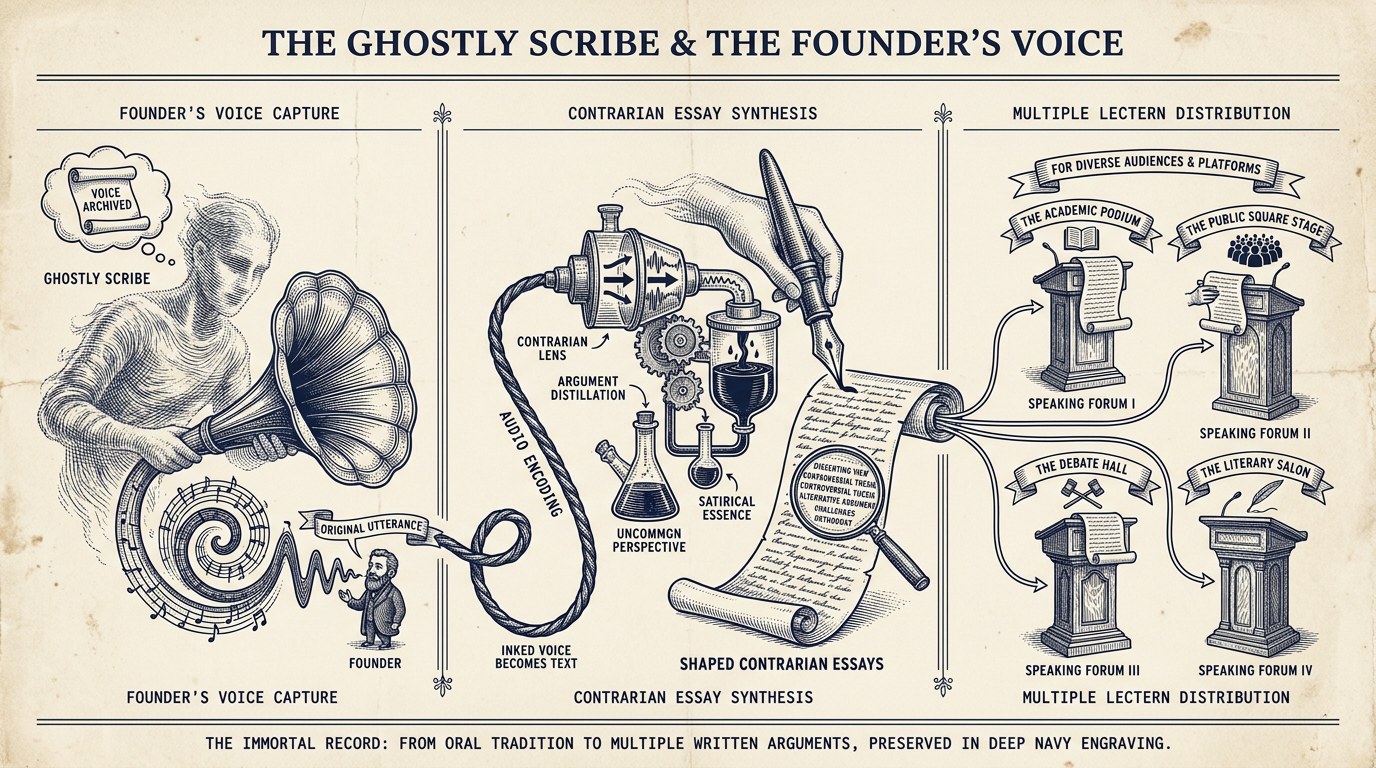
The output is sixty minutes of audio plus a transcript. The writer extracts three things from it: the executive's verbatim phrases (the actual words and idioms they use), their argument structure (how they build a claim), and their contrarian positions (what they'll defend publicly). Those three layers feed every subsequent ghostwritten piece for the next six to twelve months. After that window, the voice drifts and a recalibration interview captures whatever has shifted.
03The hook discipline
Every executive ghostwritten piece lives or dies on the hook. The hook is the first three sentences, and it has to do one specific thing: name a position the executive will defend with their name on it.
Generic hooks ("Three lessons I learned about scaling SaaS") fail the test because the executive has no position to defend. There's nothing in the framing that someone could disagree with. Operator-grade hooks pass the test because they make a claim: "Most B2B SaaS founders should stop hiring sales until $3M ARR" is a defensible position. "The smartest decision we made in 2024 was firing our biggest customer" is a defensible position. The executive will get challenged on LinkedIn and has to respond.
The hook discipline forces voice capture to produce something usable. If the voice interview surfaces five contrarian positions, each one is a hook for a future piece. If the voice interview surfaces zero contrarian positions, the executive is not actually a strong ghostwriting subject. Better to recognize that early than to produce twelve generic pieces over six months.
04Drafting in the executive's voice
Drafting against the captured voice is more constrained than drafting from scratch. The writer pulls verbatim phrases from the transcript, mirrors the executive's argument structure, and avoids language patterns the executive doesn't use. This is craft work. It does not scale by adding more writers per executive. One writer per executive, or at most two writers tightly coordinated.
The author schema attached at publish should reflect the byline executive as the Person entity per Schema.org's Person specification. This matters for AI Search citation signals: the entity-level association between the executive and the content compounds across pieces and across platforms. Generic agency-byline content does not compound this way.
What kills drafts in this phase: when the writer adds language the executive doesn't use, when the argument structure flattens to marketing-speak, when the contrarian hook gets softened during drafting. The writer's job is to be invisible. The reader should hear the executive, not the writer.
05The executive review cycle
The executive review has to fit in ten minutes per piece or the program collapses. Executives don't have ninety minutes per piece. Programs that demand ninety-minute reviews end after three or four pieces when the executive's calendar wins.
The ten-minute review structure: read the hook, confirm the position is one the executive will defend. Scan the body, flag any factual errors or specific examples that need adjustment. Read the closing call to action. Approve or send one bullet of feedback. Nothing more. The writer absorbs feedback and ships.
If the executive consistently wants longer reviews, the voice work isn't done. The drafts aren't landing in their voice. Going back to capture more voice material costs less than dragging the executive through ninety-minute reviews on pieces that should have been right the first time.
06Distribution: where ghostwritten content lives
A ghostwritten piece is not one post. It is a content asset that gets distributed across four channels minimum: LinkedIn longform under the executive's profile, the company blog if the topic fits, podcast talking points for the executive's next three to five guest appearances, and op-ed material for conference talks and panels.
The same source material drives all four. The LinkedIn post gets the contrarian hook in the first sentence. The blog post adds operational depth. The podcast version gets compressed into three to five quotable lines the executive can drop into conversation. The op-ed version reframes the position with industry context. One drafting investment, four distribution outputs.
This is where the compounding kicks in. LinkedIn's B2B Institute has documented the pattern that brand-building in B2B is a long-horizon investment, where executive content earns trust over years rather than weeks. The programs that compound are the programs that distribute systematically. The programs that publish-and-forget produce single-shot impressions and don't build the compound.
07Measurement: what executive content moves
Executive ghostwriting moves three specific metrics, and tracking these separately from generic content metrics matters. First, executive profile growth on LinkedIn: followers, post engagement, and DM volume from the right ICP. Second, inbound to the company from executive content: tracked via UTM parameters on the executive's link-in-bio and via "saw your post" in sales calls. Third, pipeline assist: deals where the executive's content shows up in the customer's research path, captured in CRM or in deal-review qualitative notes.
What it doesn't move directly: top-of-funnel SEO traffic, conversion-rate metrics on the website, or short-cycle paid acquisition KPIs. Executive content lives in the trust-building layer of the B2B buying journey Gartner tracks, where buyers research executives and companies before vendor selection. Measuring executive content against bottom-of-funnel SEO KPIs is the most common reason programs get cancelled prematurely.
08Common failure modes and operational fixes
Four failure modes dominate. The voice-flattening failure: ghostwriter produces marketing-speak under the executive's byline. Fix: voice capture interview before any drafting, plus iterative voice calibration over the first three pieces.
The hook-softening failure: the contrarian position in the brief gets watered down during drafting. Fix: hook approval gate before drafting starts. Editor confirms the hook is defensible before the writer drafts the body.
The review-bloat failure: executive reviews drag past ten minutes and the program collapses. Fix: structured ten-minute review protocol communicated at engagement start.
The single-channel failure: pieces publish on LinkedIn and nowhere else. Fix: distribution checklist at publish, reformatting the same source for blog, podcast prep, and op-ed material.
If you want this running on your executive content program, our content writing engagement covers the voice capture, drafting, and distribution discipline. Pricing for different program scales is on our pricing page.
09FAQ
How long does a voice capture interview last?
Sixty minutes recorded. Less than that and the writer doesn't capture enough verbatim language patterns. More than that and the executive's calendar pushes back, often killing the engagement before drafting starts. Sixty minutes is the floor and the ceiling.
Can one writer ghostwrite for multiple executives?
Yes, but with capacity limits. One writer can hold the voice of two to three executives reliably. Beyond that, voice drift sets in and drafts start sounding interchangeable. Programs with more than three executives need additional writers, not more capacity per writer.
How do we know if the ghostwritten voice is actually working?
Two signals. First, the executive accepts drafts with minor edits rather than rewrites. Second, audience comments and DMs reference the executive's voice and positions specifically ("loved your take on X"). When the audience starts engaging with the position rather than just the executive, the voice work is landing.
Is executive ghostwriting ethical?
Yes, when the executive defends the published positions, the voice is genuinely theirs, and the content is something they could have written if they had the time. It crosses an ethical line when the executive publishes positions they don't actually hold or wouldn't defend if challenged. The voice capture interview is the safeguard against this.
How does this differ from your standard content writing process?
Standard B2B SaaS content writing covers brand-byline content with SME interviews. Executive ghostwriting is voice work for a specific named executive with personal-byline content. The five-phase process documented in our content writing approach applies, but the brief, the SME interview (replaced by voice capture), and the review cycle are adapted for executive constraints.
Sub-pillar
Content writing for B2B SaaS
This post belongs to our sub-pillar on content writing for B2B SaaS, which sits under our content marketing pillar. See the full system for SME-grounded writing, editorial workflow, and voice.