On this page
Most B2B SaaS brands have a "voice document" that reads useful and produces inconsistent output. The document covers principles, adjectives, and aspirations. It doesn't cover the four dimensions that actually determine whether two writers produce content that sounds like the same brand or not.
We treat voice as an operational system, not a stylistic preference. The framework below is what we run.
01What brand voice actually is (not "tone")
Brand voice is the personality that runs consistently through every piece a brand publishes. Tone shifts with context: a release announcement reads excited, a security incident post reads sober, a how-to guide reads practical. Voice doesn't shift. The same brand sounds like itself in all three contexts.
Confusing voice with tone is the most common reason voice documentation fails. A voice doc that's actually a tone guide tells writers to "be friendly here, be formal there." Writers interpret that with their personal defaults and the output diverges. A real voice doc tells writers what stays constant regardless of context, which makes consistency possible.
The test for whether you have voice or tone documentation: hand a writer the doc and a topic from outside your domain (a recipe, a movie review). Could they produce content that sounds like your brand on that topic. If the doc only tells them how to write about your category, it's category guidance, not voice.
02The four-dimension voice framework
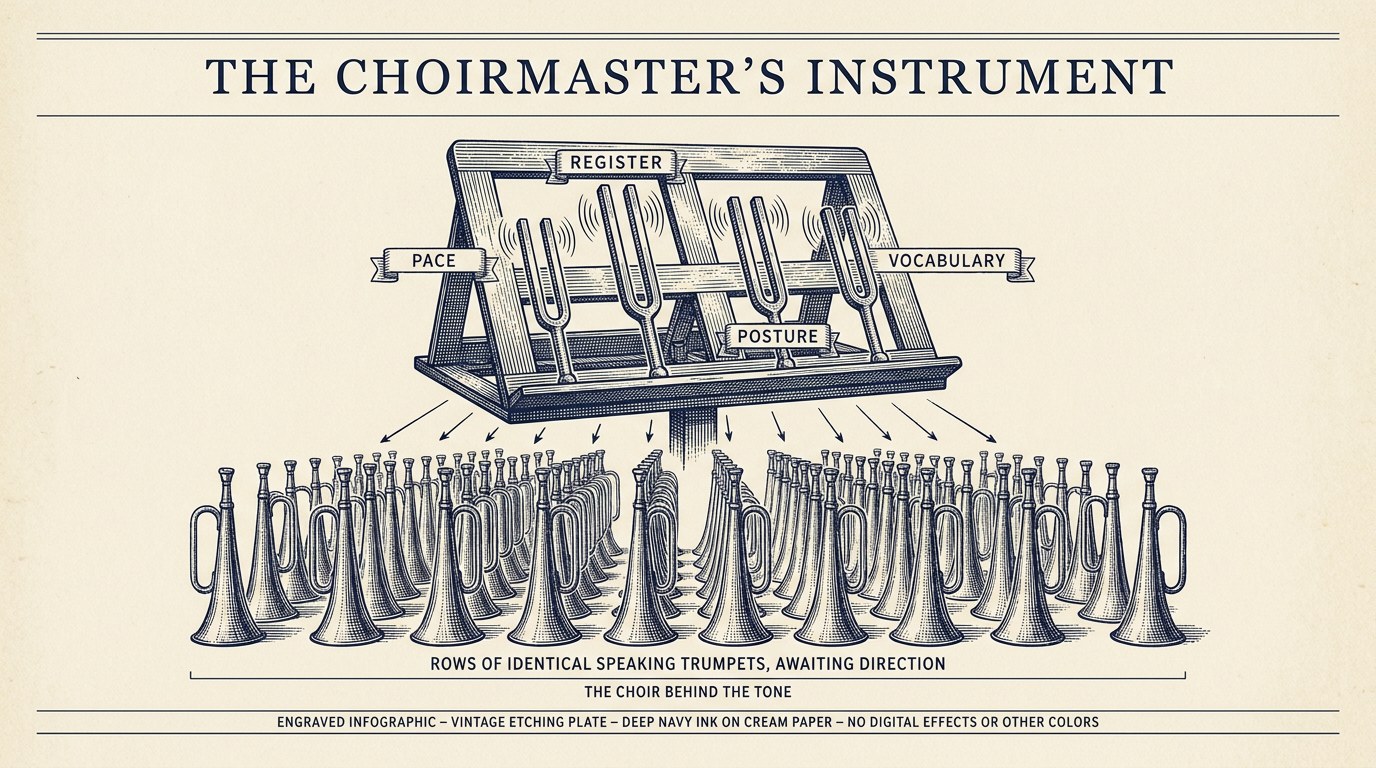
Voice covers four dimensions. Pace: sentence length distribution, paragraph rhythm, how fast claims accumulate. Some brands write in long flowing paragraphs. Others write period-heavy with short sentences. Pace is the most-felt and least-documented dimension.
Register: formality level and how it varies. Some brands stay academic in every piece. Others stay casual. Most B2B SaaS brands occupy a specific operator-professional register that's neither corporate-formal nor consumer-casual. Documenting where on that scale you sit matters more than naming it.
Posture: how the brand positions itself relative to the reader. Authority-from-above (textbook voice). Peer-to-peer (operator voice). Underdog (challenger voice). Service provider (helpful voice). Each posture shapes paragraph openings and call-to-action language differently.
Vocabulary: the words you do and don't use. Banned phrases. Preferred phrases. Industry-specific terminology that signals operator-grade versus marketing-grade content. Concrete vocabulary lists with examples are what writers actually reference, not abstract principles.
03Documenting voice: the operator's voice doc
The operator's voice doc is a working document under 10 pages with four sections matching the four dimensions, each with examples and counter-examples. Examples show how the brand does sound. Counter-examples show how it doesn't sound. Counter-examples are critical because they catch the failure modes writers fall into when uncertain.
The doc also includes three reference pieces: the best published content the brand has shipped that exemplifies voice across all four dimensions. Writers read the doc, then read the reference pieces, then write. The doc plus pieces together produces consistency that either alone doesn't.
What the doc doesn't contain: long lists of personality adjectives ("witty, knowledgeable, approachable"). Adjective lists are aspirational, not operational. Writers can't translate "approachable" into specific paragraph choices. They can translate "use second-person 'you' in every other sentence" or "avoid Latinate vocabulary when Anglo-Saxon equivalents exist."
04Voice consistency across writers and AI tools
Consistency at scale requires four mechanisms running simultaneously. First, the voice doc itself, current and accessible. Second, the writer onboarding ritual that walks new writers through the doc plus the reference pieces with feedback on first drafts. Third, the editorial QA pass that catches voice drift before publish. Fourth, the AI prompt scaffolding that embeds voice instructions into every AI-assisted task.
Missing any of the four and consistency degrades. Voice doc without onboarding ritual: writers interpret the doc through their personal defaults. Onboarding without QA pass: drift happens after the first three pieces. QA without AI prompt scaffolding: AI-assisted phases produce content that sounds nothing like the brand.
The AI prompt scaffolding is the newest of the four and the most often missed. Every AI prompt used in production should include the four-dimension voice constraints. Without that, AI defaults to median internet voice, which is not your brand's voice.
05Brand voice and the writer onboarding process
Writer onboarding for B2B SaaS programs has a specific structure that works. Week 1: writer reads voice doc, reads three reference pieces, writes a 600-word practice piece on a low-stakes topic. Editor reviews against the voice doc dimensions.
Week 2: writer drafts a real piece. Editor provides feedback specifically tagged by voice dimension ("pace too fast in Ch 3," "register too formal in opening"). Writer revises. Editor confirms.
Weeks 3 and 4: writer ships two more pieces with light voice-specific review. By piece 5 or 6, voice is internalized and editorial review can shift to content quality without dimension-by-dimension voice notes.
This works because voice is a skill, not a preference. It takes deliberate practice with structured feedback. Programs that skip the practice cycle hire writers who never quite land in voice, then fire them, then re-hire and repeat.
06Voice signals that AI search engines pick up
AI search engines and LLMs cite brands with consistent voice more reliably than brands with inconsistent voice. The mechanism is that consistency builds an identifiable entity. The brand's content forms a recognizable signature that AI systems associate with topical authority.
Three specific signals matter. Consistent author entity attribution: every piece has clear authorship, ideally with Schema.org Organization markup for the brand and Person markup for the byline author. Consistent operational vocabulary: the same terms used the same way across pieces signals authoritative source rather than aggregator. Consistent argument structure: claim-led prose that builds positions the same way signals operator-grade content.
Google's helpful content guidance reinforces this implicitly: the helpful-content evaluation rewards content that demonstrates consistent expertise and trustworthiness, both of which require voice consistency to compound across pieces.
Research published through LinkedIn's B2B Institute describes the parallel pattern in B2B brand-building: brands with consistent positioning across touchpoints compound mental availability faster than brands that drift.
07Maintaining voice as the company scales
The maintenance discipline is quarterly. Every 90 days, the voice doc gets reviewed against the most recent 10 to 15 published pieces. Three checks: is the doc still accurate, has voice drifted in published content, has the company's positioning shifted in ways the doc should reflect.
Drift is normal and the quarterly cycle is the mechanism that catches it before it compounds. The doc updates with refreshed examples. The AI prompt scaffolding updates with the refreshed examples. The next quarter's pieces ship against the updated doc.
HubSpot's State of Marketing data tracks brand consistency as a top-quartile driver of marketing performance across B2B segments. The programs in that top quartile run quarterly voice maintenance. The programs in the bottom quartile don't have a voice doc, or have one but don't maintain it.
08Common failure modes and operational fixes
Four dominant failures. The adjective-list failure: voice doc is a personality adjective list. Fix: rewrite against the four-dimension framework with examples and counter-examples.
The onboarding-skip failure: new writers get the doc and a topic. Fix: structured onboarding ritual with practice piece and feedback cycle.
The QA-bypass failure: editors review for content quality but not voice. Fix: voice-specific QA pass before publish with explicit checks against the four dimensions.
The AI-default failure: AI-assisted phases produce median internet voice. Fix: AI prompt scaffolding embedding the four-dimension constraints into every AI task.
If you want this running on your brand, our content writing engagement covers voice documentation, onboarding, and maintenance. Pricing on our pricing page.
09FAQ
How long does a voice doc take to build?
For a brand with existing published content, 3 to 5 working days. Voice doc construction works by reverse-engineering from the brand's best pieces. Brands without enough published content to reverse-engineer from need a positioning workshop first, which adds another 5 to 7 days.
Can AI write the voice doc?
No. The four-dimension framework requires judgment calls about what the brand wants to sound like, which AI can't make. AI can help with formatting and example generation once the dimensional choices are made.
How often does voice need updating?
Quarterly review, annual major refresh. Voice rarely changes fundamentally but accumulates drift across 90-day windows that compounds if left unmaintained.
What's the relationship between brand voice and product positioning?
Voice is the personality. Positioning is the strategic claim about category and differentiation. The two interact but aren't the same. Voice can stay consistent across positioning shifts. Positioning can shift while voice stays stable.
How does brand voice intersect with the content writing process?
The brief includes voice constraints as a section. The SME interview captures voice samples. The drafting phase applies the voice doc. The editorial review checks against voice dimensions. Full integration with our content writing approach.
Sub-pillar
Content writing for B2B SaaS
This post belongs to our sub-pillar on content writing for B2B SaaS, which sits under our content marketing pillar. See the full system for SME-grounded writing, editorial workflow, and voice.